


How Mutual Fund Overlap Amplifies Your Market Risk

An investor meticulously selects five different equity schemes, assuming their capital is perfectly shielded across a broad market spectrum. A closer inspection of the underlying holdings reveals that identical blue-chip companies dominate every single chosen product. Buying a larger volume of financial instruments does not automatically equate to structural market protection. Asset safety requires looking past the brand names of chosen schemes to understand the specific corporate equities actually held within them.
Key Takeaways
Holding multiple equity schemes with similar investment objectives often results in owning identical underlying stocks, defeating the primary purpose of asset allocation.
Regulatory mandates require certain fund categories to pick from restricted stock universes, naturally forcing competing schemes to purchase the exact same market-leading companies.
Investors can manually calculate their portfolio duplication by comparing monthly factsheets and aggregating the lowest shared percentage weight of each common stock.
The Mechanics Behind Mutual Fund Overlap
Allocating capital into several equity products that share similar objectives inevitably leads to holding identical securities. This specific phenomenon is defined as mutual fund overlap. It strips away the protective layer of asset separation that these financial vehicles are fundamentally designed to provide. The issue originates from the structural design of the financial markets and strict regulatory constraints.
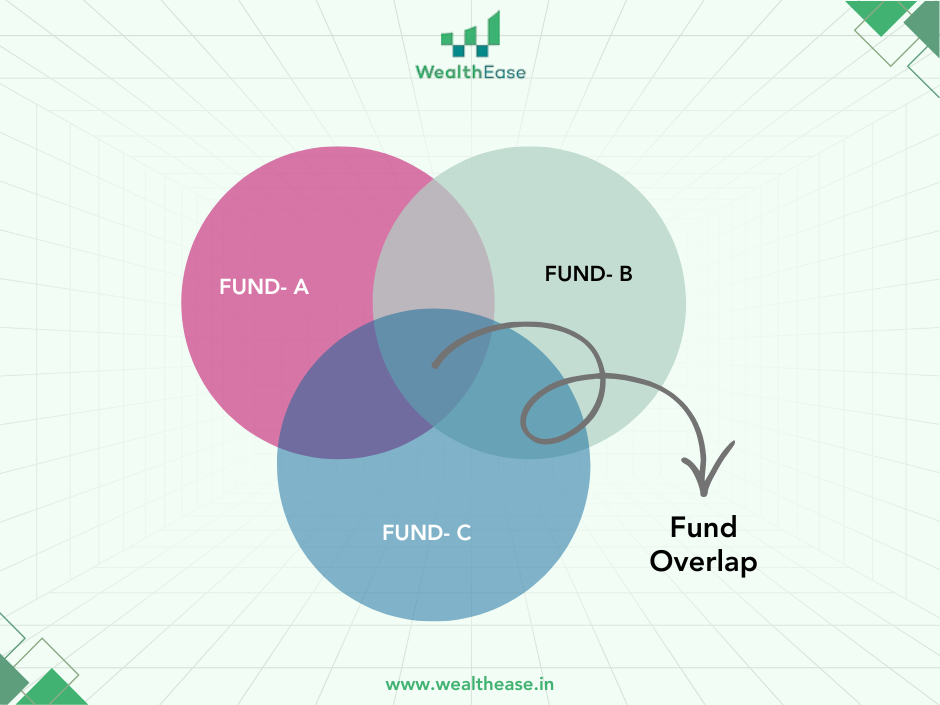
SEBI Category Mandates
Regulators strictly define the investment universe for different scheme types to ensure uniformity. The 2018 recategorization rules mandated that large-cap funds must allocate at least 80% of their total corpus into the top 100 stocks by market capitalization. This incredibly tight restriction naturally forces all competing large-cap products to purchase the exact same blue-chip companies. Mid-cap categories face similar constraints, required to invest 65% of their portfolio in the next 150 stocks. The narrower the authorized universe, the higher the guaranteed duplication.
Sectoral Momentum Tracking
Excitement around specific market trends causes multiple fund managers to flock toward identical high-performing sectors. If the technology sector or the banking space experiences a massive boom, different funds will acquire similar assets to chase those high returns. A large-cap fund and a thematic fund might both aggressively buy into the same trending financial stocks, quietly neutralizing your broader diversification strategy.
Calculating Your Mutual Fund Portfolio Overlap
Determining the exact duplication in your investments requires comparing the monthly portfolio disclosures of your chosen products. You must clearly identify the common stocks and note the distinct weightage of those specific equities in each individual scheme. A reliable fund overlap calculator method involves manually taking the lower weightage of each shared stock and adding those precise figures together.
Consider an investor holding two different large-cap schemes.
The table below illustrates exactly how shared assets create direct duplication within a standard portfolio:
Company Name | Equity Fund Weight | BlueChip Fund Weight | Overlap Counted |
Company A | 10.00% | 9.00% | 9.00% |
Company B | 9.00% | 10.00% | 9.00% |
Company C | 8.00% | 7.00% | 7.00% |
Company D | 7.00% | 8.00% | 7.00% |
Total Measured Overlap | - | - | 32.00% |
Executing a regular check mutual fund overlap routine ensures you know exactly how your capital is distributed. A thorough mutual fund overlap comparison requires evaluating the precise weight of each shared asset using public factsheets. A high final percentage clearly indicates that you are effectively buying the exact same assets through completely different financial providers.
The Structural Risks Of Duplicated Holdings
A high degree of shared holdings across your investments introduces severe structural vulnerabilities to your wealth-building plan. Your capital becomes tightly concentrated in a narrow band of companies, which restricts potential growth while actively magnifying downside exposure during market corrections.
Amplified Capital Losses: Overlapping stocks perform poorly and the negative financial impact hits multiple funds simultaneously. Losses are multiplied across your entire net worth rather than being safely cushioned by uncorrelated assets.
Unnecessary Management Costs: You pay multiple expense ratios to different professional fund managers. These individuals are essentially doing the exact same job of managing identical assets, actively eroding your overall returns.
Suboptimal Portfolio Returns: Heavy duplication severely limits your potential to capture growth in other unrepresented sectors of the economy. You miss out on the performance of unique, emerging companies completely outside the duplicated pool.
Investors must proactively compare mutual funds overlap to prevent these hidden structural risks from steadily eroding their long-term wealth. This mutual fund stock overlap completely defeats the fundamental purpose of spreading your capital across the broader economy.
Examples Of Internal AMC Overlap
The reality of this duplication becomes highly visible when examining the internal portfolios of prominent asset management companies operating in the Indian market. Historical data from August 2020 demonstrated that out of five distinct equity schemes managed by Axis Mutual Fund, exactly 11 identical stocks were present across all five portfolios.
These shared corporate assets commanded capital allocations ranging from 40% to 94% across the various products. A similar structural pattern was historically visible within SBI Mutual Fund in August 2023, where 35 identical stocks were common across at least three of their top funds, representing up to 71% of the total invested assets.
ICICI Prudential exhibited the same behavior during that period, with 33 common stocks heavily dominating multiple fund categories. Because fund managers within the same firm share a unified stock-picking philosophy, holding multiple funds from the exact same corporate entity often results in significant portfolio overlap in mutual fund characteristics.
The data shows these interconnected funds tend to move in tandem, outperforming or underperforming their respective benchmarks simultaneously.
Strategic Methods To Eliminate Portfolio Redundancy
Building a resilient financial structure requires deliberate and calculated action to separate your assets. You can actively check overlapping mutual funds and adjust your broader strategy using distinct, professional allocation methods.
Select Distinct Market Categories: Allocate your capital strictly across categories like small-cap, mid-cap, and large-cap funds. Small-cap funds possess a broader authorized universe of over 250 available stocks. This wider pool naturally limits the statistical chance of heavy duplication when strategically paired with a standard large-cap fund.
Diversify Across Competing AMCs: Choose financial products from entirely different fund houses. Different corporate entities employ distinct stock-picking frameworks and advanced data models. This structural separation naturally leads to different portfolio compositions.
Evaluate Advanced Risk Metrics: Look past basic holding percentages to thoroughly evaluate the standard deviation and the Sharpe ratio. These specific metrics help you properly understand a fund's exact risk profile and return volatility before finalizing your investment decision. Comparing these metrics across your duplicated funds reveals which product actually justifies its management fee.
Study Proper Asset Allocation: Balancing your long-term exposures requires deeply studying asset allocation principles. We highly recommend reviewing our detailed insights on Asset Allocation and Diversification Strategies to properly construct your financial roadmap. A well-constructed framework automatically minimizes the chance of buying into the same corporate assets.
Conduct Periodic Portfolio Reviews: Global markets continuously evolve and professional fund managers constantly adjust their internal holdings in response to economic shifts. An investment combination that looks incredibly safe today might develop a massive portfolio overlap of mutual funds next year due to natural market drift. Regular monitoring ensures your capital remains appropriately dispersed.
Before we conclude the blog, let us invite you to a 1:1 financial planning session.

Conclusion
True diversification requires continuous vigilance and careful strategic planning. A bloated portfolio full of redundant funds gives a false sense of security while secretly concentrating your capital in a few select equities. By systematically measuring your exposure and stripping out duplicated assets, you regain absolute control over your financial trajectory.
FAQs
How to calculate the overlap between two portfolios?
Compare the monthly holdings of both funds to find common stocks. Check the percentage weight of each shared stock in both funds. Take the lower percentage for each stock and add them all together to find the total overlap.
How much overlap in mutual funds is good?
An overlap below 10% is generally considered healthy and acceptable. A slight duplication is unavoidable, but if the shared holdings exceed 33% to 40%, your portfolio faces dangerous concentration risks.
Why do funds in different categories share the same stocks?
Fund managers from the same asset management company share similar investment philosophies and biases. This shared corporate approach leads them to pick the same high-performing companies across different fund categories.
Does holding more mutual funds improve diversification?
Adding more funds does not automatically spread your risk. If the new funds invest in the same underlying companies as your existing funds, you are simply duplicating your exposure and increasing your management costs.
How does portfolio overlap affect my investment returns?
Heavy overlap limits your potential gains because your capital is tied to the same few stocks. If those companies underperform, the losses are multiplied across your entire portfolio, leading to suboptimal overall returns.


Comments