


Nifty India Defence Index: Performance, Risk, and the Geopolitical Edge

Introduction
Be fearful when others are greedy and greedy when others are fearful.” — Warren Buffett
Financial markets have always been deeply intertwined with global events, and few forces influence them as powerfully as wars and geopolitical conflicts. Periods of uncertainty, whether triggered by military tensions, cross-border disputes, or large-scale wars, tend to shake investor confidence, disrupt global supply chains, and alter government spending priorities. In such times, markets often react sharply, reflecting both fear and opportunity.
While broad market indices may experience volatility during conflicts, certain sectors behave differently. Defense-related companies, for instance, often witness increased attention due to rising government expenditure on security, modernization, and strategic capabilities. This shift in spending can translate into stronger order books, improved revenue visibility, and, in many cases, upward momentum in stock prices.
This dynamic is clearly reflected in the Nifty Defense Index. Unlike traditional indices, its performance is closely linked to geopolitical developments and national security priorities. As tensions escalate or defense budgets expand, the index tends to capture these shifts, making it a unique lens through which investors can observe the intersection of markets and global conflict. Against this backdrop, it is important to examine how the Nifty India Defense Index hasperformed over time. The index was launched on April 2, 2018, with a base value of 1,000 points.
The defense sector in India is not a single, uniform industry but a diverse ecosystem comprising multiple interconnected sub-sectors. These include aerospace and aviation, focusing on aircraft, helicopters, and drones; naval systems and shipbuilding, involving warships and submarines; and missile and strategic systems, which deal with advanced weaponry.
A significant portion also lies in defense electronics, including radar, communication, and electronic warfare systems, as well as ammunition and explosives that form the backbone of military operations. Additionally, defense engineering and precision manufacturing support the production of artillery, armored vehicles, and critical components, while specialty chemicals and materials enable the development of propellants and high-performance inputs.
The sector is further complemented by defense mobility and logistics, which ensure operational readiness through military vehicles and transport systems. Together, these sub-sectors create a comprehensive defense manufacturing ecosystem that reflects both technological depth and strategic importance.

The composition of the Nifty India Defense Index, as illustrated above, reflects a concentrated yet well-defined basket of companies operating across different segments of the defense ecosystem.
Nifty Defense Index vs Nifty 50: How Geopolitics Drove Sectoral Outperformance
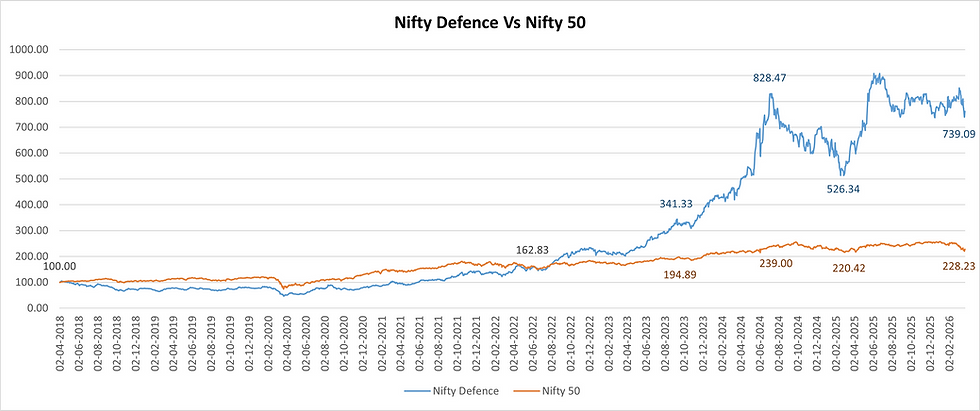
The performance of the Nifty India Defense Index over the past eight years reveals a pattern that is closely aligned with key geopolitical events, both global and domestic.
In the initial phase (2018–2019), the index remained relatively subdued, broadly tracking the Nifty 50. This period was marked by relative global stability, though events such as the India–Pakistan tensions following the Pulwama attack in 2019 briefly brought defense to the fore. However, the impact on long-term market performance remained limited.
The sharp decline in early 2020 corresponds to the outbreak of the COVID-19 pandemic, which triggered a global market crash. During this phase, even defense stocks were not immune, as economic uncertainty overshadowed sector-specific positives.
A major turning point came in 2022 with the Russia–Ukraine war. This event significantly altered global defense dynamics, leading to increased military spending worldwide. India, too, accelerated its defense procurement and indigenization efforts, as reflected in the strong upward movement of the Nifty Defense Index from around this period.
Another important factor has been the ongoing India–China border tensions, particularly since the Galwan Valley clash in 2020. This led to a sustained push to strengthen domestic defense capabilities, benefiting companies in the index over the following years.
From 2023 onwards, continued geopolitical instability, including conflicts in the Middle East such as the Israel–Hamas war, further reinforced the importance of defense preparedness globally. Alongside this, the Indian government’s continued emphasis on “Atmanirbhar Bharat” in defense manufacturing, higher budget allocations, and export growth created strong structural tailwinds for the sector.
The sharp rallies and intermittent corrections observed during 2023–2025 can thus be linked to evolving expectations regarding defense orders, policy announcements, and developments in global conflict. Overall, the index’s trajectory clearly demonstrates that defense stocks tend to outperform during periods of heightened geopolitical tension, making the Nifty India Defense Index particularly sensitive to such events. Similar shifts in performance leadership can also be seen in Nifty 50 vs Nifty Next 50 vs Nifty 100, where returns vary across segments depending on underlying market conditions.
Performance & Risk Metrics of Nifty India Defense Index
Metric | QTD | YTD | 1 Year | 5 Years | Since Inception |
Price Return (%) | 4.90 | 4.90 | 58.36 | 54.00 | 30.32 |
Total Return (%) | 5.13 | 5.13 | 59.28 | 55.60 | 31.98 |
Statistic | 1 Year | 5 Years | Since Inception |
Standard Deviation | 26.68 | 27.23 | 26.72 |
Beta (vs Nifty 50) | 1.13 | 1.06 | 0.85 |
Correlation (vs Nifty 50) | 0.50 | 0.53 | 0.54 |
The returns clearly highlight the strong recent performance of the Nifty India Defense Index. Over the past year, the index has delivered a price return of 58.36% and a total return of 59.28%, significantly outperforming broader market benchmarks. Even over a 5-year period, returns remain robust, indicating that the rally is not just short-term but also supported by structural growth in the defense sector.
From a risk perspective, the standard deviation remains relatively high (around 26–27%), suggesting the index is more volatile than traditional large-cap indices. This is expected, given the sector’s sensitivity to policy changes, order flows, and geopolitical developments.
The beta of 1.13 (1-year) indicates that the index is more volatile than the Nifty 50, meaning it tends to amplify market movements. However, the lower beta since inception (0.85) suggests that this heightened sensitivity is a more recent phenomenon, likely driven by increased investor interest and sectoral momentum.
Correlation with the Nifty 50 remains moderate (around 0.5), suggesting that while the index moves with the broader market, it also has distinct drivers. This makes it a potential diversification tool, as its performance is influenced not just by economic cycles but also by defense spending trends and geopolitical factors.
Overall, the data reinforces the idea that the Nifty India Defense Index offers high return potential, albeit with higher volatility, and behaves as a partially independent sector driven by unique macroeconomic and geopolitical forces.
Fundamentals
Metric | Value |
P/E Ratio | 52.26 |
P/B Ratio | 10.85 |
Dividend Yield (%) | 0.56 |
The fundamental metrics of the Nifty India Defense Index indicate that the sector is currently trading at premium valuations. A P/E ratio of 52.26 suggests that investors are willing to pay over 52 times these companies' earnings, reflecting strong growth expectations rather than current earnings strength. This is typical of sectors that are in a high-growth phase, where future order inflows and earnings visibility drive valuations.
Similarly, the P/B ratio of 10.85 is significantly elevated, indicating that the index's stocks are trading at many times their book value. This often reflects the market’s confidence in the sector’s ability to generate high returns on capital, as well as the strategic importance of defense businesses, which may not be fully captured by traditional balance sheet metrics.
On the other hand, the dividend yield remains low at 0.56%, suggesting that these companies are not primarily income-generating investments. Instead, they tend to reinvest earnings into expansion, capacity building, and technological development, which aligns with the defense sector's long-term growth narrative.
Overall, the fundamentals suggest that the Nifty India Defence Index is growth-oriented and sentiment-driven, with valuations supported by strong policy backing, increasing defence budgets, and rising geopolitical relevance. However, such high valuations also imply that the sector may be sensitive to any slowdown in order inflows or changes in government spending priorities.
Before we conclude the blog, let us invite you to a 1:1 financial planning session.

Conclusion
The journey of the Nifty India Defense Index over the past eight years clearly illustrates how financial markets are not just driven by economic fundamentals, but also by geopolitical realities. From moving in line with broader indices in its early years to significantly outperforming them in recent times, the index has evolved into a distinct reflection of global tensions, domestic policy shifts, and strategic priorities.
The strong returns, coupled with relatively high volatility, highlight the dual nature of the sector offering substantial growth potential while being sensitive to external developments. Its moderate correlation with the Nifty 50 further reinforces its role as a differentiated investment avenue, driven by factors beyond traditional market cycles.
At the same time, elevated valuations suggest that much of the optimism is already priced in, making the sector susceptible to corrections if expectations around defense spending or order inflows are not met.
Overall, the Nifty India Defense Index stands at the intersection of markets and geopolitics. For investors, it represents not just a sectoral bet but a thematic play on national security, global conflict dynamics, and India’s long-term push towards self-reliance in defense.


Comments